What’s up everyone. My name is Pono Van Dusen. I am a freshman at Chapman University, currently enrolled as a biology student. Although I came to school in hopes of pursuing a degree in a Pre-Medicine pathway, I have an undying love for movies and would love to have a future in the film industry. I am currently in the process of applying to transfer into the film school at Chapman. My blog is going to be talking about current events and things I’m passionate about. If you love movies, sports, music, poetry, or need insight on college life, this could be the blog for you! Thanks y’all.
COVID-19
Introduction
Whether we find ourselves scavenging through our local grocery stores while masked, or cancelling group plans for the foreseeable future, the COVID-19 crisis has affected everyone in some shape or form. With the uncertainties of each day lingering into the next, I thought it would be very important to document this unsettling time. This autoethnography will describe the events of the COVID-19 global pandemic of 2020, a time that will be historically remembered by the lethal virus which not only has killed over 300 thousand people worldwide, but also has significantly damaged global economics. My autoethnography will specifically describe the effects the COVID-19 pandemic can have on a family, my family to be exact. This paper is primarily driven by my own experiences during COVID-19. From having to transition from the best moments of my life in college to being stuck at home, this pandemic has definitely had a negative effect on my life. The perspectives of my family members during this time will also provide insight into more harrowing challenges they’ve had to face over the past few months. While most of this piece will discuss the primary research conducted through my family and myself, I’d also like to address how my community has been affected by the pandemic. I think it’s very important to include information of how my community is doing during this time, as my surroundings are an essential piece to my story. Throughout my autoethnography, I will seek the answer these three driving questions:
How has COVID-19 affected my life so far?
How has COVID-19 affected the lives in my household?
How has COVID-19 affected the lives of those in my community?
Methodology
For the primary research portion of my autoethnography, I will be telling my own story of my life before and during the COVID-19 crisis. I have also conducted three separate interviews that encompass three very unique perspectives of my family members. The primary research will show how the pandemic can affect a single family in many different ways. My secondary research conducted for this autoethnography consists of online research, primarily through statistics, and timelines that represent COVID-19 in Oregon, specifically the areas around me. I’ve also gone out into the city to take pictures to get a visual representation of how the pandemic has affected the city of Portland.
Primary Research
My Perspective
Act I: Before Quarantine
My first semester at college was tough. Struggling through my first year biology student courses, I wasn’t enjoying my life at school. Most of my time was spent stressing out over every assignment and barely grazing by with mediocre grades. With my workload increasing dramatically for the second semester, I was honestly really scared. I dropped all of my biology classes and applied to Dodge for film, meaning I needed to raise my GPA for their requirements. Through a lessened workload, I was already feeling much better about college. I was able to be more social, going to my first college parties in the middle of second semester. My friends and I went viral on Tik Tok, and we were always excited to keep making videos together. I started my modeling career with the help of my friend, Jaden. It felt like the stars were aligning and I was finally in the right place. Then, things got weird. Suspicions of the Coronavirus became more prevalent everyday. Yet, my friends and I were pretty unfazed. We thought school would get cancelled and we’d still be able to skate and party. Even on the infamous day where everyone at Chapman got the email saying school would be going online for the next eight weeks, we celebrated. To us, no more going to class meant more time to do fun stuff. Chapman later emailed us saying to go home immediately if possible. This is where the story gets messed up.
Act II: The Transition
After the news broke that Chapman was going to continue school online, there was a very strange feeling all around campus. If I could describe it, I would say it was deep sentimental uncertainty. Everyone greeted each other with questions, unknowing what the situation was and whether or not this would be the last time we’d see each other. Although this period was hectic and often sad, I kind of enjoyed how everyone treated each other. It was a real sense of community. Every meal at the Caf and every skate session lasted longer than normal. We’d just sit, talk and hug afterwards; it felt meaningful. I spent lots of time just sitting in my dorm room with my roommate Owen, laughing about all of the messed up moments we shared together. We were all just trying to get some sense of closure, even though the situation wasn’t really allowing it. We celebrated the final nights together, then one by one, everyone began to go home. The day I left Chapman was surreal. My best friends still at school all spent the day helping me pack up my things. We took pictures in my room, documenting the last moments I’ll ever have in North Morlan 260.

I gave Owen one last hug, and hugged all of my other friends who were crying at this point. My best friend Amber drove me to the airport and we listened to all of the songs that reminded us of the good times we spent together over the semester. Saying goodbye to her was the hardest. In the blink of an eye, I was on the plane going home, wiping down everything with disinfectant wipes, unable to process what just happened. It felt like the best time of my life was wiped away in a couple of emails.
Act III: Quarantine
The next few weeks were dull. I was stressed out because all of my stuff was still in my dorm room, but my uncle who lives in Yorba Linda was able to move everything out for me in a single afternoon. I was happy to be home since I’m a little bit of a homebody. Sleeping in my own bed felt amazing at first, but I couldn’t help but think of all of my friends still in Orange. I couldn’t help to be sad about what just happened. I immediately felt an immense stress about finishing the semester at home and online. I was left with nothing but memories of better days. For the past couple months, I’ve been spending the majority of my time in the confines of my room. Although I could easily sleep in everyday, I try a decent amount to stay productive by learning how to cook and deliberate binge-watching. With more free time on my hands, I’ve been able to work out nearly everyday with my dad, which is the only thing keeping me motivated. Being at home and having to take online classes is one of the most difficult things I’ve ever had to accomplish, not due to the difficulty of my classes, but because it’s very hard to stay motivated for school. This is something that’s taken a toll on my mental health due to the fact that I need to maintain a good GPA to be in a safe position for my Dodge application. Going online has prevented me from ever feeling like I’m doing as best as I could in any of my classes.
In conclusion, the COVID-19 pandemic has definitely affected my life in a negative way, yet I am so lucky to be in the position I am today. At times, things can look very bleak and I may be so confused about my life, but then I realize that everyone is feeling that way. COVID-19 has allowed me to spend some quality moments with my family that I’ll cherish forever. I’m lucky to be able to be here and be conducting this autoethnography in good health, while my family and friends are also in good health. Personally, the pandemic has had its effects, but it’s not something I can’t handle. I’m trying my best to stay optimistic through it all.
Rain:
My youngest sister, Rain, is currently finishing up her senior year at the University of Oregon. Although she’s graduating this year, the COVID-19 pandemic has prevented her from being able to finish her college career in person. Rain was forced to move home from her apartment in Eugene early due to the campus closure. It’s been rough transitioning from in person to online classes, as all of her classes were intended to be taken in person. The school has yet to release a statement about having a graduation either in person or online. She said that after four years of grinding in school, it sucks that she doesn’t get a proper ending.

Rain’s had the same roommates since she was a freshman. When news broke that everyone had to return home, she was the last one to leave their apartment. Rain said that one day she woke up to an empty house. Everyone had moved out, she was scared and lonely, and it was overall a cold ending to her college experience with her roommates. Their plans of going to Las Vegas and Coachella during the semester were cancelled due to the pandemic. Rain is particularly sad about missing those shared moments with her best friends.
It’s hard to always know what you’re doing after college, but it’s even harder to know what to do during a global pandemic. Rain has an added layer of stress because she originally intended to take time after school to figure out what she wanted. She said she’s trying not to be so hard on herself because things are scary enough right now.
Ultimately, Rain said that quarantining has taken a toll on her life. She misses being around her friends and her routine to keep her in check. Since COVID-19 ruined so many of her future plans, she feels her mental health is all over the place.
Brooke:
My oldest sister Brooke is currently seven months pregnant with her first child. Before COVID-19, her life was on a promising path. She was up for a big promotion at work and in her second trimester of her pregnancy. She was planning for the future while enjoying life in San Francisco.

In terms of her pregnancy, COVID-19 stripped away a lot of the excitement and normalcy of having a baby. Her doctor’s appointments were scheduled by necessity and conducted over the phone. Due to restrictions, her future visits are limited to only her entering the building. On the day of the gender reveal, Brooke went through the process alone, having to share the news with her boyfriend, Key, waiting in the car. She’ll be very limited to the amount of people accompanying her during her delivery, and she has to be extremely cautious of the people around the baby after she’s born. She is mainly saddened about how she’s unsure of when her baby can meet family members and whether or not she can have a baby shower.
Having a baby while living in San Francisco is ridiculously expensive. COVID-19 forced all Paper Source stores nationwide to temporarily shut down. Brooke was one of sixteen managers that was able to stay but on reduced pay. Key was unable to keep his job at the hotel. While worrying about the financial stability during Brooke’s pregnancy, they had to move home to save money months before they planned to. Brooke’s work is conducted in a completely restricted way with less pay, Key is looking for work, all during a pregnancy that requires a lot of money.
Overall, Brooke is great at staying positive. She said that she feels good mentally and physically, but wishes she just had a week to decompress.
Dad:
My father is the primary source of income for the family. As an orthodontist of twenty years, this is the only period of time where my father has had a prolonged time not working; he hasn’t gone in to work since March. He’s been using his “sick bank” time, as well as his vacation days that he’s built up over the years to maintain income while their office has been closed for months.

His main concerns during this pandemic are about his staff and his patients. The majority of the staff at his office are on furlough unemployment with hopes of coming back to work. He worries about his patients who are worried about their teeth, people who are due to get their braces taken off or their invisalign completed. The longer applications stay on teeth, the harder it is to stay healthy.
My father has to work in an entirely different way when he returns. He’s only allowed to work one day of the week where he sees around 15 patients a day instead of his normal 80 patients. Appointments are spaced out, he’s wearing more personalized protective equipment, and he’s without the majority of his staff. Work is going to be slow, meaning he’s not getting paid as much due to being paid on production. They’re staying away from aerosol equipment, and over-sanitizing the entire office.
This time has made my dad think about not only his future, but the future of dentistry and orthodontics. Because of the economic problems and the fact that orthodontics is an elective service, less people are going to spend on dental work.
Overall, my dad’s been enjoying his time away from work. He’s wanting to retire soon, so this was just a taste of what retirement is like. Throughout the pandemic, he’s been staying positive, but the change in lifestyles wasn’t ideal.
Interview Analysis
Before interviewing two of my sisters and my father, I had a basic understanding of their situations. I knew their lives were more affected by the virus than anyone else in my family, but I was unaware of the specifics of the problems they were dealing with. By learning more about their stories, I was able to further grasp their feelings through this tough time. The interviews made me greatly appreciative because it made me realize that these people in my family are going through things that I was unaware of, yet they never show it. Everyday, everyone is trying to be as normal and optimistic as possible even when things aren’t looking to be in their favor. I’m very grateful to be surrounded by such a loving family and I’m thankful they were so open and helpful to lending their stories to my autoethnography.
Secondary Research
Portland, Oregon is home to 664,103 people, and it’s where I like to call home, with Beaverton being a mere ten minute drive from downtown. Typically, the city of Portland is extremely lively, with streets filled with local businesses, coffeehouses and food trucks. Due to the events of the COVID-19 pandemic, the areas around me have changed drastically. The statistics as of today state that there’s over 3,623 confirmed cases and 137 deaths in the state of Oregon. 2,431 of those cases were found in Multnomah, Washington, and Marion County. I live in Washington County, and I’m surrounded by Multnomah and Marion, therefore I’m in the most prominent region for the COVID-19 virus in Oregon. Although the numbers may seem daunting, Oregon is actually in the lower half of states for COVID-19 cases, and I accredit that to how well Oregonians are social distancing. Oregon has abided by the rules of a statewide school closure. By April 8th, every school in Oregon finished their year online or terminated completely. Oregon’s economy has also been heavily affected. Since March 23rd, our governor Kate Brown has issued a state-wide stay at home order, which only allows essential businesses to stay open. Throughout this time, most local businesses have been either forced to conduct their business in a way where safety precautions are applied extremely to lower the curve of transmissions, or temporarily stop business altogether. This pandemic has also caused job losses for a great mass of Oregonians; as of today, well over 300,000 people have claimed unemployment in the state. Another way that COVID-19 has altered the lives of Oregonians, specifically in the Portland area is the cancellation of the NBA season. A Portland staple, and one thing that really brings the community together is the camaraderie of TrailBlazer games. Because of COVID-19, the NBA took precautions and cancelled the rest of the season, a season in which the Blazers were fighting for a playoff spot, something my friends and I were greatly looking forward to.
I went to the city with Brian to take pictures and see if I could visually document the effects COVID-19 had on the city. It was surreal to see the streets of a normally booming city practically empty.

This picture shows a “Street Closed” sign in front of the Moda Center, where the Blazers would be playing if not for the pandemic.

Portland’s famous Arlene Schnitzer Concert Hall sign next to an empty street and sidewalk.

COVID Graffiti
COVID-19 has obviously had an effect on Portland, as if all of the people, sounds and sights that gave the city life had vanished.
Conclusion
By conducting this autoethnography, I’ve gained a deeper sense of appreciation for my family, friends, and community. I’ve gotten emotional thinking about the memories that I’ve had and cherished before quarantine, and I hold them closer to myself today. I wrote this project from a place of great privilege. My family and I are healthy and able. While I talked about our struggles, these struggles don’t compare to the hundreds of thousands that are losing loved ones to this virus. It’s made me more self-aware and grateful for my life, and I’m praying for a better tomorrow for everyone.
Works Cited
Coronavirus (COVID-19). (n.d.). Retrieved from
COVID-19 Related Business Layoffs, Closures, and Unemployment Insurance Benefits.
(n.d.). Retrieved from https://govstatus.egov.com/ORUnemployment_COVID19
Pappas, S. (2020, May 15). Oregon: Latest updates on COVID-19. Retrieved from
https://www.livescience.com/oregon-coronavirus-updates.html
Portland, Oregon Population 2020. (n.d.). Retrieved from
https://worldpopulationreview.com/us-cities/portland-population/
Staff, A. K. G. W. (2020, May 17). Oregon coronavirus updates May 17: No new deaths reported
for third straight day. Retrieved from
The New York Times. (2020, April 1). Oregon Coronavirus Map and Case Count. Retrieved
from https://www.nytimes.com/interactive/2020/us/oregon-coronavirus-cases.html
autoethnography analysis
As I compare the secondary research I’ve conducted to my primary research from family interviews, there’s a lot to be analyzed. I’ve only interviewed my youngest sister so far, who is currently a senior at University of Oregon. I’m still looking forward to interviewing my father, who is an orthodontist who is currently not working due to governmental restrictions, and my sister Brooke, who is six months pregnant.
I’ve been looking at an interesting Forbes article that talks about how college students, specifically graduating seniors are affected by the widespread closure of college campuses. My interview with Rain, my youngest sister, is driven by this idea of having an unexpected, alternative ending to her college career, one in which she describes to be “not preferable”. She states that she’s “disappointed, with nothing she can do about it”. These feelings of disappointment and feelings of hopelessness seem to be very common for all students, but they definitely hit harder for students like my sister who have reached the pinnacle of their academics, only for it to end abruptly. Our interview conducted was a lot like the ones shown in the Forbes article. One student stated, “it’s like reading nine chapters of a book, and then having someone tell you how it ended” (Forbes). I asked my sister what she thought of the quote, and she felt that she related to it. Because it’s an autoethnography, I’m also talking about my own experiences in college and how I was sent home from Chapman. I feel sympathy for my sister and all of this year’s graduating class, yet I don’t think I could ever truly understand what they’re going through. Rain’s interview is very similar to articles explaining feelings about this year’s graduating class because all of them share the commonality of this disappointment. From the beginning, I believed that my sister would have a clear stance on the topic that was predictable, but I still find her insight valuable because it’s very different from my experience. Although being away from campus is tough, I love being home all the time because I’m a little bit of a homebody, and I have next year to look forward to. Rain has to stay home with our parents who are bothering her about finding a job once this quarantine is over.
So, what does it all mean? I believe my interview with Rain shows that college kids, specifically college seniors, are all greatly affected by being away from campus, but in different ways. For my sister’s class, graduating college is stressful enough. My sister had no idea what she was going to do after she was done with school, and now this quarantine has only added another layer of stress and disappointment. A specific question that came up for me that I’d like to dive into is “how do you think COVID-19 is going to affect jobs for kids coming out of college?”. I think it would be very interesting to see if the economy shifts enough to where Rain might pursue something because of the altered economy due to Corona.
Thanks for tuning in for my last blog post!
covid ethnography
Hello everyone! Long time no see. I hope everyone reading this is doing okay and is staying indoors. Speaking of staying indoors, I am writing my upcoming auto-ethnography on COVID-19, and more specifically how its affected my life and the lives of those around me. This time has been tough on everyone, and I’d really like to be able to write about my thoughts and feelings over quarantine. Although COVID-19 is a pandemic that is obviously affecting the entire world, I’m going to focus my project on a smaller scale. My primary research is going to consist of interviewing my family members, including my father who’s been dismissed from work for the past two months, my sister who won’t be able to walk at her college graduation, and my oldest sister who is expecting her first child. My secondary research is going to consist of some overviewing facts about COVID-19 as a whole, but mainly research on how COVID-19 is affecting Oregonian students, workers, and expectant mothers.
I found a great website from one of my local news stations, KEZI 9, that has a timeline of every major event that has gone down in Oregon so far with COVID-19. One fact that surprised me about the facts shown on this website was how close to home the first few cases were, which then rapidly spread to areas all around the state. The first case of Coronavirus was found on February 28th. Someone who worked in the Lake Oswego School District was the first person to contract COVID-19. Lake Oswego is fifteen minutes away from my house. By the time I had to leave from Chapman, there had already been 36 cases of COVID-19 (KEZI 9), which was more cases than Orange County had by the time I left (LA Times). It seemed to me that I was moving back home to where COVID-19 was more dangerous than on campus. As we can see now, COVID-19 is prominent nearly everywhere us Chapman students relocated to.
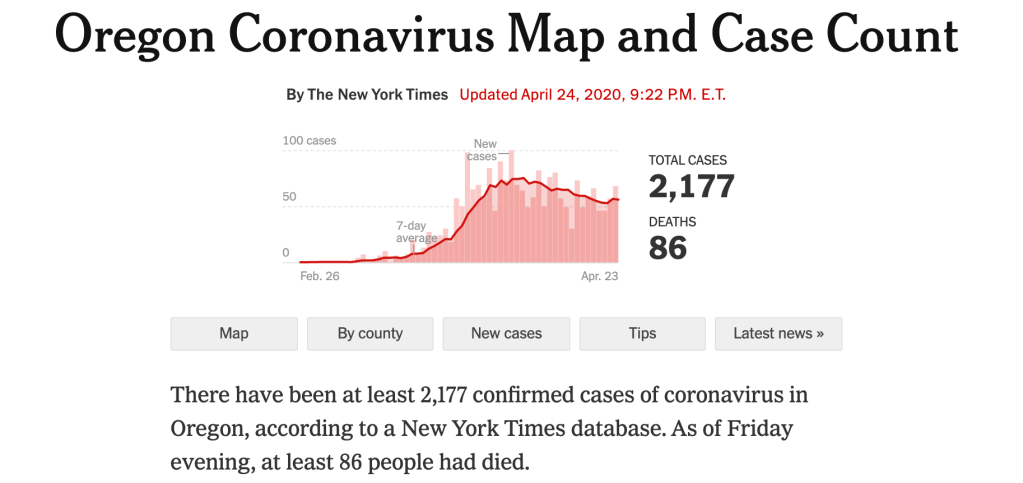
From the first case of COVID-19 that occurred in my county, to today, we’ve seen a rapid increase of cases in Oregon. As of today, Oregon has had 2,177 cases and 86 deaths, and this graph shows how rapid of an increase we’ve faced over the past two months (New York Times).
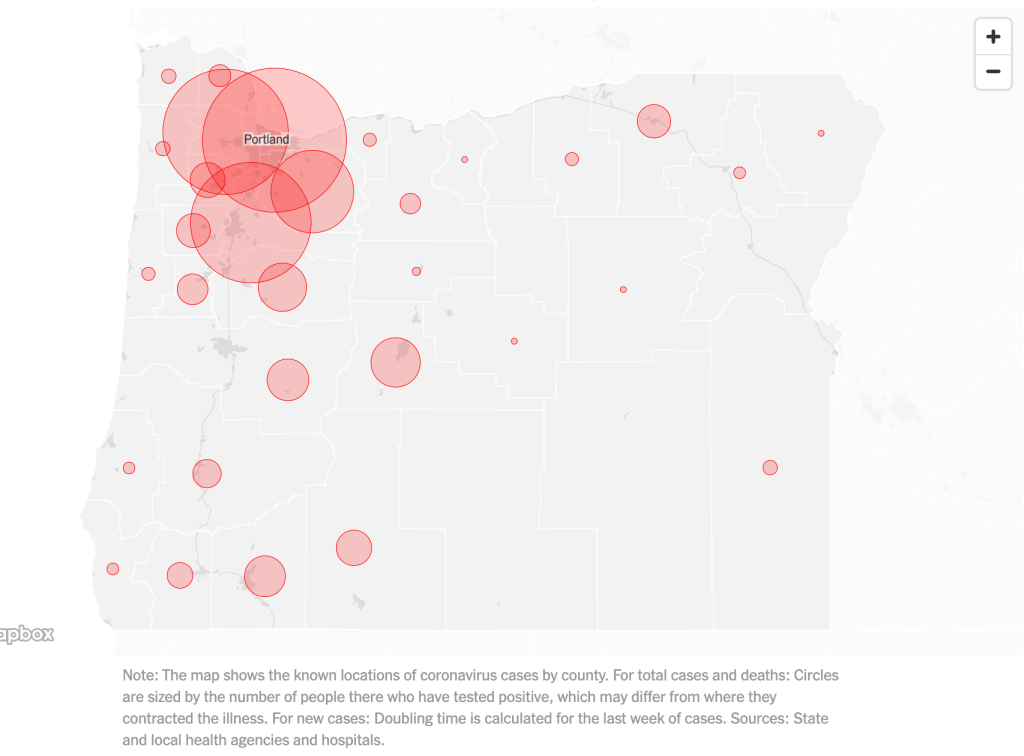
This map shows how prominent COVID-19 is in the county that I live in. I live in Beaverton, which is about 15 minutes away from Downtown Portland. As you can see, there are cases spread out all around the state, yet the biggest circles are found in Portland (New York Times).
While I continue to search for more secondary articles and statistics to help strengthen my project, I hope to look deeper into not only general facts but also how COVID-19 is affecting prospecting mothers like my oldest sister. For now, I think the websites I’ve been using have been leading me in the right direction for this project.
metacognitive reflection
- The purpose of my wix website is to give my audience a little bit of insight on my interests and the people in my life that have made me who I am today. I hope that my readers enjoy how the site looks and how it reads, and I hope they can take away a few things about myself. I want my audience to know that I am very family-oriented and I care a lot about being creative and finding comedy in life.
- This process was a very nice change in pace from the rhetorical analysis paper we wrote. I loved being able to create a visual that I felt suited my personality and enhanced my website as a whole. It was easier to accomplish because I was more motivated to make everything look how I wanted it to. Traditional essays can sometimes be so boring, so I’m glad we were able to do something like creating a website.
- I really just wanted to make my website look clean and simple, but aesthetically pleasing. I chose the pictures that I thought told the story of my life the best; the pictures that suited my personality. I wanted to choose pictures and videos that make me feel something, mainly great nostalgia. I love how some of the film photos look, especially the ones of my parents. Mainly, I just want my audience to be able to feel something as well, hopefully joy.
- The layout of my website was simple. I wanted to make something bold, yet laid-back because that’s what suits my personality best. My most important task in making the website was giving my audience something simple and nice to look at. I didn’t want to be gimmicky, I just wanted my pictures and excerpts to be the main focus.
- I hope I achieved a voice through my website that creates and one on one relationship with my audience. I want to be a friend telling the things I think are worth telling about myself. Sometimes it gets personal. At the same time, I kept my stories pretty brief, so I can interest my audience in potentially wanting to read more. I wouldn’t want to read something greatly personal in someone’s photo essay in this format. Ultimately, I hope my audience is able to be happy when reading my writing pieces.
Website Link: https://vandusen8.wixsite.com/mysite/identity
corona
As a naturally born introvert, I’m thanking the coronavirus under the rug for letting me stay in my room all day with no negative repercussions. I haven’t had this much time to watch movies and sleep in awhile. Yet, obviously, this is a selfish way of looking at the situation. To be honest, the past couple weeks have sucked the life out of me, and many of those around me. You could see it when you walked around the dorm rooms at campus. No one knew what to do, and when receiving the news that we had to head home, we pretty much gave up. It was like the school year ended then and there, and we had no sense of closure. The last day at Chapman was pretty sad as I had to say bye to the best friends I made during my time in Orange, yet it was so abrupt that it felt unreal. Now, I’m typing from my home in Beaverton, Oregon in the confines of my room, missing all of my homies. While there are many cool aspects to this pandemic, the bad is seemingly outweighing the good, and I’m scared of the rapid spread of coronavirus.
I’ve had to stay inside my home ever since I returned from college. Although this time is stressful for most, I’m taking my time trying to catch up on my studies and relieve the stress of school. Being forced to take online classes is a great challenge for many students, including myself. If I’m staying in my room all day, it’s hard to find it within myself to be productive. Therefore, I’m going to have to work harder than I have all year to maintain decent grades through the end of the semester.
Also, I’m taking this time to just be mindful of my surroundings. Things are so hectic and scary right now that just a couple of minutes everyday to sit, reflect, and meditate can go a long way. My parents are both pretty old, and it’s a daunting feeling to think of them becoming ill from coronavirus. So, I’m using my time to be considerate of others around me. I know that coronavirus isn’t necessarily going to affect me because I’m young, yet, my parents and many other kids’ parents are at risk. This isn’t about us kids. We just have to do the right thing and stay inside and stay to ourselves. I think if we’re all mindful of each other and continue to be responsible quarantiners, we can stick this out and things will hopefully get better. It’s important to call and text your homies and family members and let them know you love them because you never know what’s going to happen tomorrow.
See y’all next week. On the blog, obviously. I’mma be in my room.
orange high school video
emotion story
My fingernails are trimmed down to the point where the skin underneath is almost fully exposed. Not from a manicure, but from my vigorous bite. My hands are running through my hair. The sweat from my palms is keeping my hair out of my face. The beats per minute of my heart turn into a marching drum and then a heavy metal song. I don’t want to be here, but I am. I need this test more than I need to drive home or eat dinner tonight. Scores determine my fate, and I prayed they would be high. My college career relies restlessly on the score I can finesse on this test. Anything less than a thirty, and I know I won’t be sleeping tonight. God, why didn’t I study. Too late now. Or is it? Maybe I can look up a few practice questions on my phone before they hand the tests out. Shit, the proctor is looking. She’s going to take my phone away. The stale air in this gymnasium is filling my brain. I can’t keep my hand still enough to even write my name properly. I can’t do this. I look to my buddy Brian across the room for some reassurance, only to see him with the same freaked out look on his face. My heart is in my stomach, and my stomach is out of my control.
“STUDENTS, YOU MAY NOW BEGIN YOUR TEST.”
Oh my God. What if I forget everything? My hands are getting the pages of the booklet wet with every turn. I see the first question of the test through a blurred vision and try my best to answer it. My stomach turns with my mind. I’m pacing back and forth in my chair. Can I go to the bathroom? No. I’m trapped. The walls of the gym are closing in on me. I look around to see everyone else. Head down, writing with precision, page turning and page turning, no worries. This pushes me over the limit. I tap my pencil rapidly to search for the answers I can’t find. At this point, I’m just trying to push through this struggle, making sure I fill in every bubble even if it means scribbles. I probably will fail my ACT, but at least I didn’t die on scene. This feeling instantly goes away when the proctor tells us to stop, yet it only continues when I realize I must wait to hear back for my score.
reflecting on rhetorical analysis
Throughout the past couple of weeks in our writing class, we’ve been working on understanding rhetorical devices and how they can be used to persuade an audience. By looking at various pieces from prolific speakers like Martin Luther King Jr., or even hip-hop artist, Childish Gambino, we saw firsthand how effective some of these rhetorical practices can be. Mainly, rhetoric is broken down into persuasion via ethos, logos, and pathos. These are used to specifically tap into an audience’s psyche through credibility, logic, and emotions, in order to make them feel or see things from your perspective. One of the main points I took away from our lessons in rhetoric is that unknowingly, we use these rhetorical devices everyday in some shape or form. They can be something as simple as tone, storytelling with emotion, or confidence when speaking to others. These practices can enhance your abilities to convey stories and ideas to your peers in different and more meaningful ways. This is something to keep in mind when looking at Phyllis Mentzell Ryder’s article about rhetorical analysis in a real world setting. They state that it’s not just something used for school papers, but something that can be used to empower conversation when you take into account how things are being said.
For my rhetorical analysis, I wrote about one of my all-time favorite skateboarders, Rodney Mullen, and his TED Talk that was filled with ethos, logos, and pathos. If you look at its surface, you can see that Mullen is able to give a great speech that is engaging the audience throughout. After learning and discussing what it means to be rhetorically persuasive, we can see that Mullen is deliberately trying to use emotional storytelling, analogies, and a charming tone to heighten the connection with his audience.
For me specifically, I struggle a lot with rhetorical devices in real life. I’ve been in tons of situations where I’m unconfident with a timid and shaky tone, therefore, I’m unable to clearly get my message across. Examples would include social awkwardness when speaking to professors about grades or when asking a peer for a favor. This has gotten in the way of certain opportunities, yet, I’m optimistic in becoming more confident in speech to be more persuasive in general. I think it’s really important to be able to find small advantages that can differentiate your way of speech for the better. Being a confident, persuasive voice in conversations can take you a long way in life.
Thank you for tuning in this week, I’ll see you soon.
“no one is 100% ready for college, and that’s ok”
I remember staring up to my ceiling fan in the middle of the night. My heartbeat was faster than the fan turned. I spent the entire summer not having a worry about leaving home for college. Yet, in my final week in Oregon, this is how I’d spend my nights. Looking up with a racing heart, and going through all of the questions that had no answers.
How badly would I miss home? Will the kids like me? How do I do laundry without my mom’s help?
Can I get through this?
Am I good enough?
I became deeply afraid of leaving home, as I’ve never lived on my own before. I went to like one sleepover camp when I was a kid, and even that was death-defying for me. I believed moving away meant moving on from my friends, and that in itself is a harrowing feeling. With immense self-doubt, I’d tell myself I was going to get eaten alive in school. After spending the past couple months convincing myself I had everything figured out, I realized that I was completely lost. But, one night I realized, that’s ok. I was not alone in these feelings.
I kept repeating the same phrase over and over to myself.
No one is 100% ready for college, and that’s ok.
When I arrived to Chapman, so many of my concerns faded away instantly. I was able to become really close with the people in my dorm, and it made the transition way smoother than I could’ve asked for. In football, people say that your nerves always go away after the first hit. That’s how it felt for me. I was dropped into this new environment, and I couldn’t really do anything besides try my best to keep up and have fun. My problems were all based on my confidence issues, so I’d say the best advice I could give to someone like me is to just always keep your head up and don’t be afraid to socialize. College is tough to navigate, and even tougher if you do it all alone. Being a good friend, maintaining good study habits and relationships with professors, and making time to exercise and relax will take you far in college. If you can take care of the little things and worry less, your questions will be answered and your worries will diminish.
The students I talked to Orange High were pretty awesome. All of them seemed like they had everything figured out, but I could tell they had some nerves deep down about the next level. Like many students, their main concerns were about finances. My advice would be to pick the school that has the best mix of affordability and personal fit. I told them that it’s ok to be lost. I’m going into my sophomore year as a former biology student wanting to study film. I’m still lost to this day. But, I take it day by day. All I can do is keep striving to be the best person and student I can be, and if I’m actively trying, then I’m happy.
Thanks for peeping the blog. You’ll be just fine. See you next time.
what’s the meaning of all this memeing
Can you scroll through your Twitter feed without finding a hilarious meme within the first few minutes? What about checking your Instagram explore page without seeing the newest Worldstar HipHop or Daquan meme? Being a Gen-Z boy spending more time on my cell phone than my parents could have ever wanted, I’ve been exposed to memes and meme culture since the Facebook days. I’m sure most of you reading can relate to this exposure, as memes have become a mainstay in our daily lives and our senses of humor. Spending all this time being involved in this culture leads me to question a few things.
Is there a point to memes?
Have we been wasting our time on stupid, meaningless jokes with low-hanging fruit comedy?
Or is there more?
In Heidi Huntington’s article “Subversive Memes: Internet Memes as a Form of Rhetoric”, she argues that memes have rhetorical properties that can compete with more dominant forms of media. She brings up a few points including how their subversive nature leads to a widespread appeal that isn’t seen in more common forms of media. She states that a semiotic approach can lead to finding symbolism and deeper meaning in the content, leading to an internet discourse of deep dissections of memes.
Her argument brings up some good points, but I think she’s looking at memes from a completely different viewpoint than kids do today.
To me, memes are supposed to be for brain-numbing laughs.
The more avant-garde, obscure, and niche the better.
And typically, the less serious thought put into memes and discourse, the more we can get out of it in terms of entertainment.

This is a Tik Tok meme of Enya Umanzor, who goes by @enjajaja online, where she’s pretending to order Chipotle. She repeats “put some more, c’mon don’t be shy, put some more” in regards to her food, theoretically harassing a Chipotle worker. The camera angle is fish-eyed and close, presenting her in a comedic fashion. There really isn’t much to the joke besides the delivery, physical and situational comedy. It’s a funny reference that a lot of kids can relate to, and many people are quoting it till this day. It’s dumb, and it’s worthwhile.
The state of meme culture today isn’t about finding deeper meanings in the memes. I believe once you try too hard to understand or grasp any sort of serious social commentary out of memes, you’ll end up nullifying the enjoyment of the meme experience itself. Memes are here and will always be here as an escape from gritty realism. They’re for quality references, internet bonding, and jokes our parents would never be able to comprehend.
Thanks for listening this week, and protect memes from getting too serious. And I’m putting that on Periodt.
 pono's blog